Rave Against the Machine
Abandoned buildings bumping an R&B fusion to Kraftwerk’s electro-synth music took over Detroit’s real estate in the 80s and 90s. Poverty rose and riots took over the city due to economic decline and racism continuing to divide neighborhoods.
Marginalized communities found solemn in these torn apart and vandalised buildings and birthed what young adults yearn for today: The American Rave Scene.
As music technology advanced in the 80s and 90s, post-industrialization theories challenged if humans and machines could coexist. An experience society had in the 80’s and 90’s mirrors similar artificial intelligence today.
Going from worshiping famous bands like Led Zeppelin and The Doors, counter cultures focused on a single person mechanically producing entrancing sounds by mixing technology with samples of music that already exists. Yes, still a technological aid but still a person working creatively in the background to assemble what we know as techno.
But the “machine” is just a tool used in a community that was built by humans no matter their race, gender or sexuality.
Minorities of the time were much more outcasted than they still seem to be at times so techno was a weapon against conformity. These abandoned warehouses became a fresh and inviting home for women and members of the LGBTQ+ community to be open and feel safe while doing so.
Raving against the machine in the 1990s took on a sense of hippie idealism of the 1960s with the installation of P.L.U.R. With its common misconception, some believed P.L.U.R meant you could not fight back, but ultimately it meant you can still resist just without violence.
Raving’s political roots of rebellion and its ability to help escape from the day to day horrors in a non-violent way, makes sound in the present day with collectives speaking out about America’s injustices through peaceful protests.
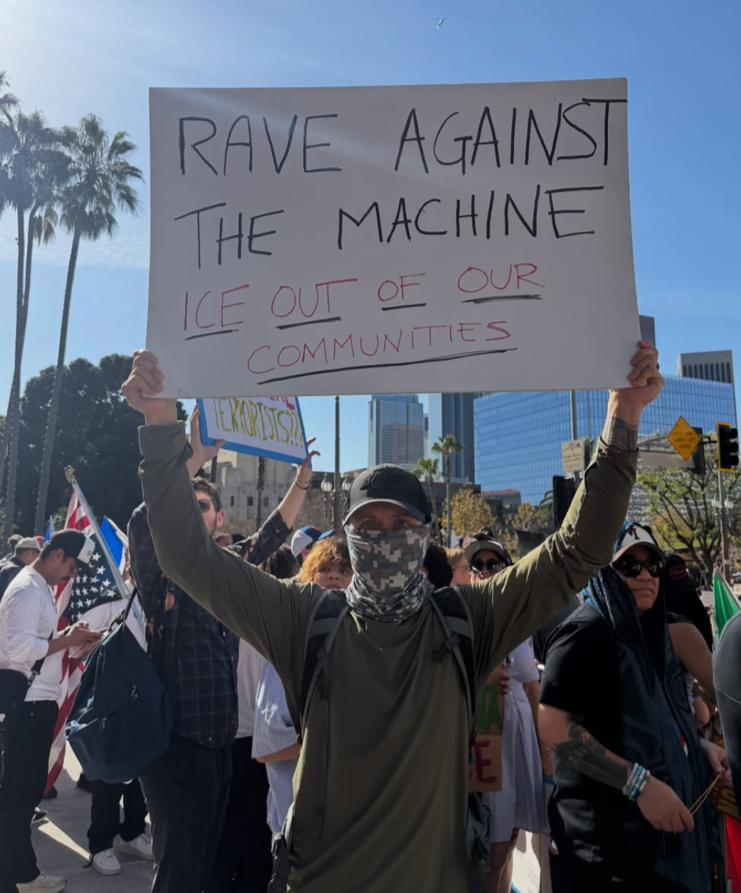
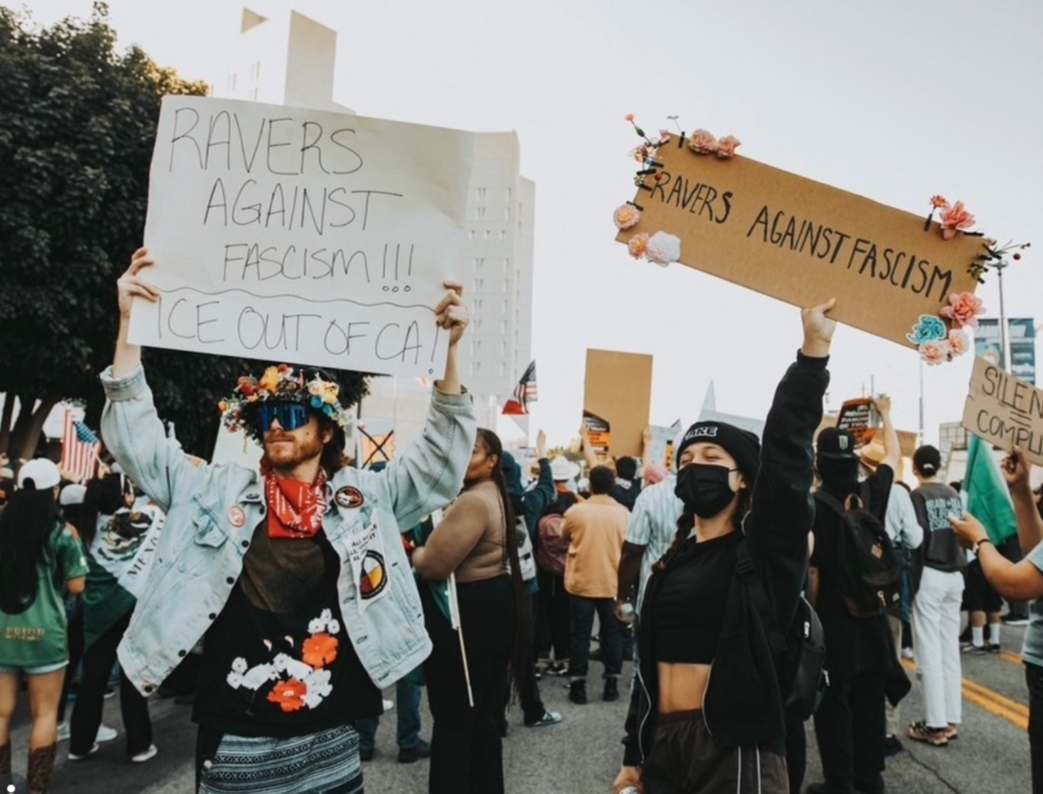
The local collectives to me (Sarah, Hi) such as 6amgroup, a global rave community out of Los Angeles and The LA Raver, a queer and women-focused collective protested against fascism while holding signs that say “Rave Against the Machine” and "Rave Against Fascism”.
I also noticed a few memes surfaced online begging novice designers to get back on Canva, a basic graphic design application that was recently clowned on in the past by Adobe Photoshop users, instead of using AI to generate their event flyers.
Event flyers of the 90s and 2000s individualized party crews and remain archival to ravers as well as an inspiration for collectives today.
With possibly no access to a computer or printer and just made from the creative vision in one’s head, rave flyers were unique. Collectives have spoken out about the use of AI in the arts (specifically regarding flyers) but with its rapid advancement and infiltration into our everyday lives, it can be difficult to avoid.
But this large community centered around acceptance and human connection should use its power to rave against the machine, MORE!!!
Already, Gen Z is the most free generation historically and minorities are using that freedom to stand up against discrimination, such as raving.
I (Sarah, again, hey) use raving as a political statement 100%!!!!
It is so important to me to find a niche and underrepresented community that I fit into that is just as against the establishment as they love to dance…like me!
Dancing gave me a scene of sexuality and femininity when I was growing up, I never felt either of those. Girls are always told to be lady-like in a cute and vulnerable way but I think being lady-like means being sexy and sweating and letting go of all of your inhibitions in a world that is constantly dragging you down.
I could wear a dress and sit with my legs crossed and still be called a wh*re, so might as well flail my body across the dance floor and kiss three guys by the end of the night to really show them… RAVING IS POLITICAL!
I would like to leave you with a quote from Researcher, Bogomir Doringer, who said in his project ‘Dance of Urgency’ that dancing is a reaction or a response to the crises of collectives or individuals’. He said you need to move to resolve something, such as fear, insecurity, restlessness, possible death, and often you also move to find others like yourself.’ He finished with where entertainment-focused dance is rose-tinted, pretty and palatable, urgency-driven becomes its younger, irreverent sister. It comes with grit and gnarl, and it is not for the fainthearted.
Sarah Van Buskirk can be reached at bysarahvanbuskirk@gmail.com
0 Comments Add a Comment?