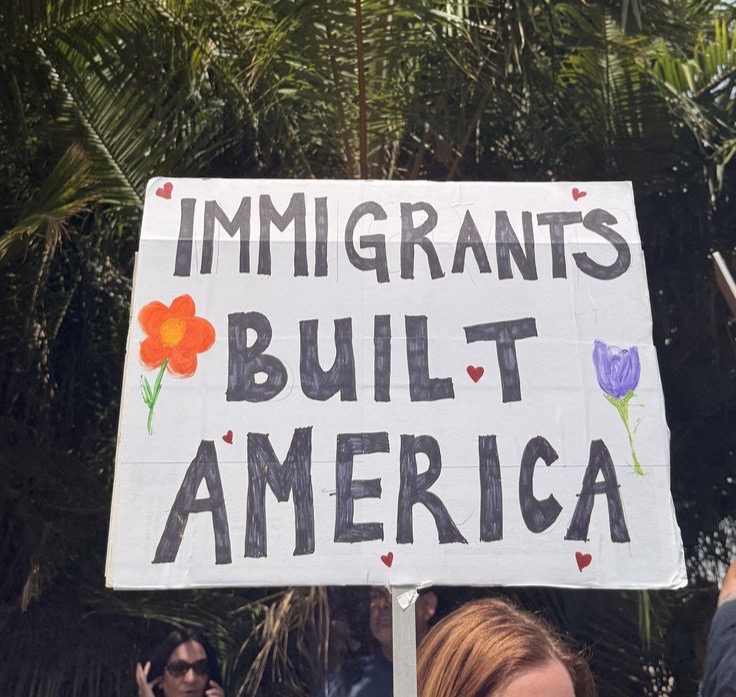
Know Your Rights Against Ice
On the morning of March, 18, 2026, students at California Western School of Law in San Diego, Calif. were in class like any other day when they received a sudden, jarring email from Dean of Students Lisa Ferreira:
“Dear Students,
Many of you may have heard by now that ICE agents were in front of the law school and detained an individual this morning. This individual is not a member of our law school community.
I would like to remind students that the law school is a closed campus, and we have a plan in place should ICE agents attempt to access any of our buildings.
Thanks to the students who helped and provided information to the individual's mother.
If you are interested in learning more about your rights, please be sure to attend the upcoming program on March 31, at 1:00 p.m. to 2:30 p.m.
As always, if you have any questions or concerns, please reach out to me.”
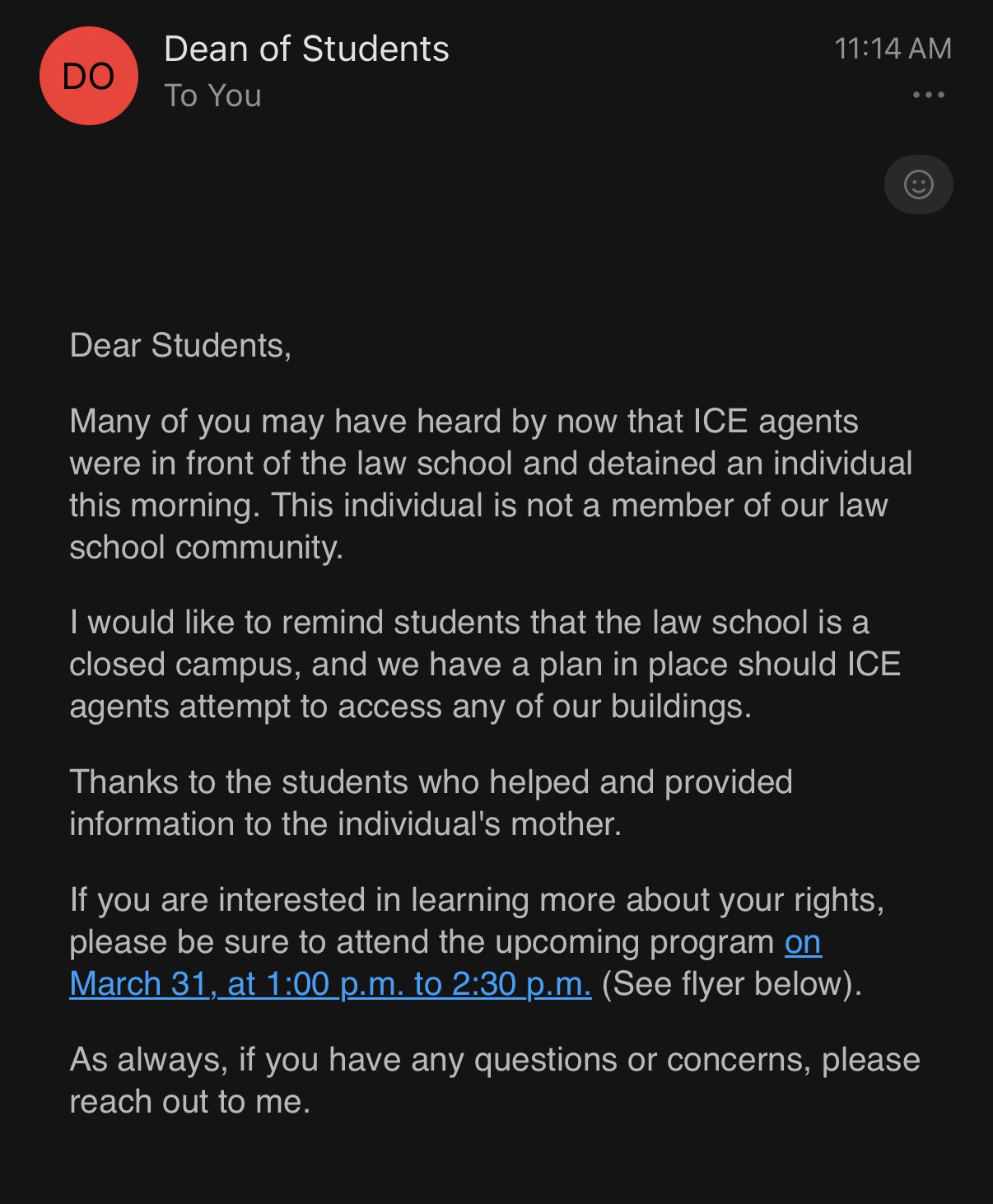
This email was provided by a student from CWSL.
Following the January 2025 rescission of sensitive location policies, Immigration and Customs Enforcement (ICE) can now legally conduct enforcement actions on U.S. college campuses, public and private institutions alike. Agents may enter public areas without a warrant to detain students or staff, while non-public areas, such as dorms or offices, require a judicial warrant.
In response, many universities and colleges have established procedures and are conducting seminars, like the one listed in CWSL’s email, to alert students of their rights and offer any support during such trying times.
This is not the first time ICE has acted on campuses. While no direct statistics have been released, as of Feb. 27, 2026, ICE was reported making arrests at Columbia University, using “questionable legality,” according to The New York Times.
Los Angeles issued a statewide emergency following ICE’s ongoing, intense immigration enforcement raids across Los Angeles County in 2025 and early 2026. Hundreds of arrests occurred, separating families and spreading fear within immigrant communities. Residents took to social media to spread alerts upon ICE sightings, urging people to stay alert.
And stay alert, we must. I never thought I would live to see the day where families were not safe in their own homes, where students were fearful of pursuing a higher education, where a young woman is fearful to drive in her car because she might be profiled, or where a little boy might be separated from his parents. But here we are.
My Nana immigrated to the United States from Mexico when she was a child. More than anything, she and her family immigrated to the States with the American dream at heart: A fresh start, a new life. The snickers regarding their accents and the grimaces towards their skin tones did not dissuade them. And when they were deported, they returned years later when she was a teenager with a fierce promise within their hearts: They would make a life here. And she did. Four children, nine grandkids and four great-grandchildren carry on her legacy and Mexican-American heritage in our spirits. Though she passed in 2019, her ferocity lives on in me, alongside the rest of my family.
My Nana was always so proud of her Mexican heritage, but she always referred to herself as an American. And why shouldn’t she? Was America not founded on the backs of immigrants? Isn’t what makes our country beautiful the intricate mixture of cultures and histories? Haven’t we learned enough from our past mistakes that these nightmarish raids should seem impossible? Apparently not.
If not for my Nana’s bravery and passion for her dream of a new life with better opportunities in America, I would not be here today and neither would my family, as is the case with millions of other first- and second-generation Americans.
With the immigration raids still ongoing, it is important for you to know your rights against ICE.
As the National Immigrant Justice Center says, “All individuals in the United States have rights, regardless of immigration status.”
If you are pulled over, per the U.S. Constitution, know that you have the right to remain silent and do not have to discuss your immigration or citizenship status with police, immigration agents or other officials. If an agent asks to search you, you have the right to say, “No.”
Agents do not have the right to search you without a judicial warrant or a probable cause. If you have been arrested by the police, you have the right to a government-appointed lawyer. You do not have to answer questions about where you were born, whether you are a U.S. citizen or how ever else one may have entered the country. Note that separate rules apply at international borders and airports, and for individuals on certain non-immigrant visas, including tourists and business travelers.
If in the situation where you are arrested or detained, you may exert your right to remain silent and to a lawyer. For more information, please visit American Civil Liberties Union’s website, aclu.org.
If you are in need of support, please visit
- California’s Rapid Response Networks’ website and/or refer to their list of hotlines for your area
- Los Angeles County Office of Immigrant Affair’s website
- OC Rapid Response Network
- San Diego’s Office of Labor Standards and Enforcement’s page on Knowing Your Rights: What to Do if ICE Comes to Your Workplace
Please continue to be safe and to know your rights.
Taylor Moore can be reached at bytaylormoore@gmail.com
0 Comments Add a Comment?